
05·Marketing
Living Homes
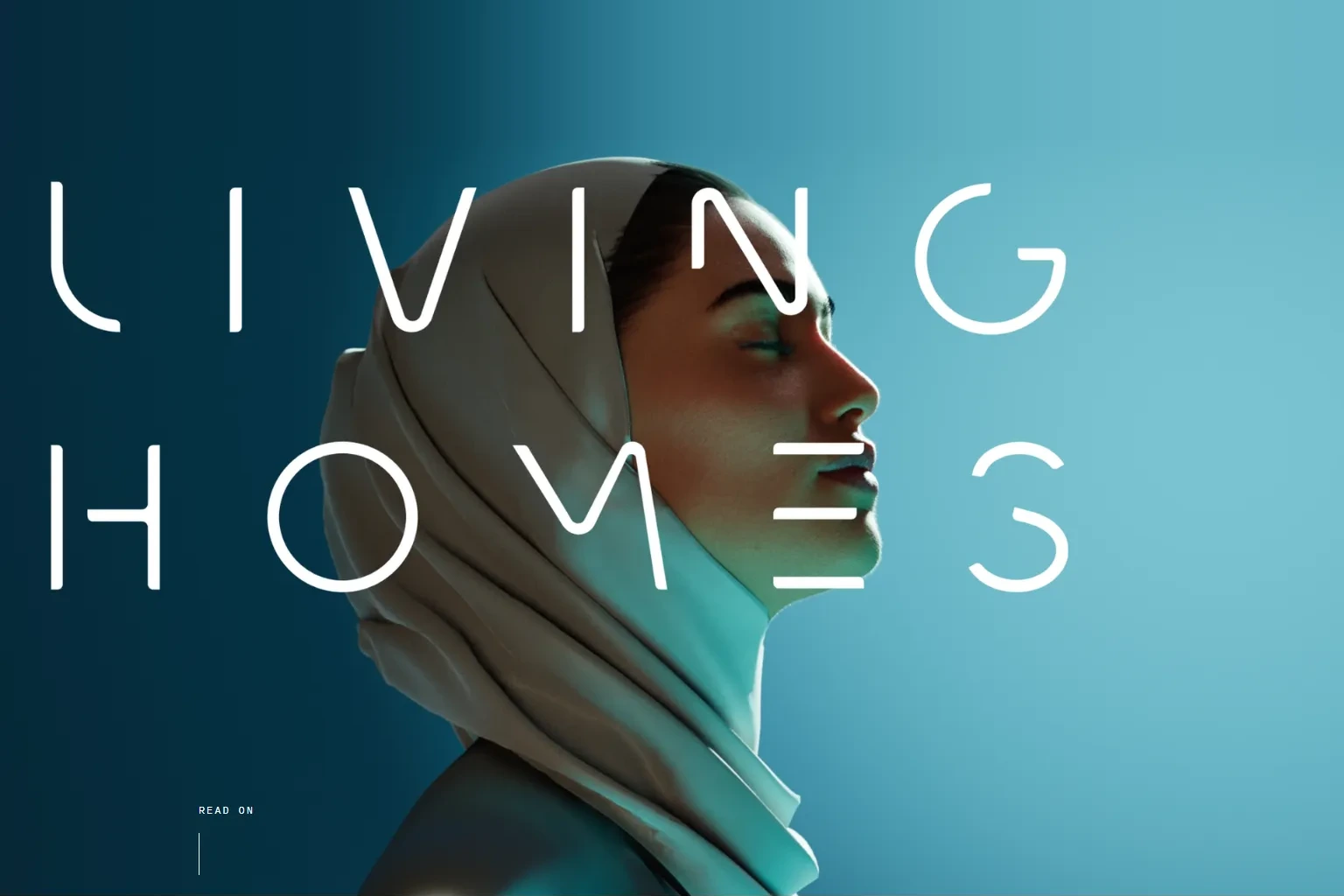
Two strands of marketing and partnerships work for Living Homes, an AI-native home OS in Dubai. A brand book closed page by page, then a landing page built on it: internal proposal work, issued for review and not adopted, so the live brand was not changed. Separately, a real broker sales-journey script for the Revi x Living Homes showroom, a physical AI-home demo unit built with a Dubai developer and used for real investor tours.
Two different states, not one.
[ Ask about this build ]Why it exists.
The company had a brand identity deck at edition 02 and a live website. The deck named a typeface it did not use, left its four voice example phrases as blanks, gave the logo a page with no clearspace, no minimum size and no misuse rules, and left the colour combinations unresolved. The website argued the company across twelve sections and showed the product in use zero times.
So the order was reversed. The book gets closed first, page by page, and then the landing page is built on the closed book. That way the page cannot invent a colour or a typeface, and the two artefacts cannot drift, because there is only one set of decisions and the book holds it.
Every image in both artefacts is an AI-generated concept render: the rooms, the people, the names they are called by, and the interface drawn beside them. None is photography and none depicts a delivered project. This is internal proposal work, prepared in role and issued for review. It has not been approved, it has not been adopted, and the live Living Homes brand is unchanged.
The brief.
Close every decision the existing brand identity left open, in the book, and only then build the landing page on the closed book, so neither artefact can invent a colour, a typeface or a rule the other has not agreed to.
What it took
Skills behind it.
Primary discipline plus the support stack.
Skills demonstrated
- Creative Direction
Closed the open decisions in an existing brand identity, one page at a time, then art-directed a landing page against the closed book so the two cannot drift.
- Web Design
A six-room landing mockup that follows one mechanism the whole way down instead of listing features, built on a grid and type ladder derived from the book.
- Marketing & BD
Positioning and copy for two go-to-market approaches, the smart home retrofit and the off-plan building spec, drawn as a pair rather than explained as two products.
- Creative Content QA & Ideation
Rewrote the identity's adjective rules as measurements anyone can re-run, and printed the two frames and the one cover that fail them. Wrote the broker-facing sales-journey script for the Revi x Living Homes demo unit at Souk Al Bahar: eight chapters compressing one full day, three timing variants branched by who is touring, and a recovery-line playbook for when the voice assistant misfires mid-demo, so a broker never has to apologise on the product's behalf.
- Frontend Engineering
Self-auditing plates: a component sheet that reads the built page through a hidden same-origin iframe, so a spec and its build cannot silently disagree.
The build, in full.
How it came together and the decisions on the record - kept off this page so the case study stays a read, not a scroll.
Read the full build notesWhat shipped.
Two different states, not one. The brand book and landing page were not adopted: the book was assembled and left awaiting sign-off, the page is a mockup whose form is not connected to anything, and two pieces of brand copy were written as recommendations rather than applied. The Revi showroom script is the opposite case: a real demo unit, a field-ready script locked for a real investor showcase, and the product shown in continuous live use across a full walkthrough, which is the thing the landing page's own proposal argues for and shows zero times.
The book is twenty sheets at 16:9 and the page is six rooms, measured at 11,703 pixels at desktop width and 13,486 at phone width with its own audit clean at both. Neither is adopted. What is still open is written down rather than smoothed over: two frames fail the grade rule the book states and are printed as failures rather than quietly dropped, two pieces of brand copy are recommendations that have not been signed off, and the interiors put the human steward on screen in the assistant's voice, which the colophon discloses without claiming either figure supersedes the other.
Edition 03 at 16:9, condensed from edition 02's thirty-seven pages
One full day compressed, arrival to balcony coffee. Real and shipped
20/25/35 min, branched by who's touring: press, investor, or serious buyer
On the (unadopted) landing page, counted across its twelve sections
Selected from the work.
8 frames
01The hero. AI-generated concept render 02The proposition, and the four things the company sells 03One mechanism in four steps, rather than nine features. AI-generated concept renders 04The assistant, shown before it is described. AI-generated concept renders 05The two approaches, drawn as a pair on one screen 06What each one fits, sits on and covers, and where the product sits 07The team and the milestones, as the company publishes them 08One ask at the end, and a note saying the form is not wired up
See also
Generative Video & Creative
Launch films for branded residences, made at BARNES Dubai: Marina Sozopol directed end to end, Maison Margiela co-directed. Real footage, 3D renders and AI video.
House Call
A multi-tradition natal-reading practice synthesising Western, Chinese BaZi and Vedic Jyotish, with predictions logged so they can be checked.
SEO · AEO · GEO Toolkit
An audit toolkit for staying visible in AI answers as well as Google search: paste a URL, get separate readiness scores and a prioritised plan.