Pavlo Puzikov
Menu

Dubai · 2026

Back to work

12·Marketing

SEO · AEO · GEO Toolkit

In productionOwner, research playbook, toolkit, scoring model, dashboard.2 min read348 words

An audit, scoring, and first-party measurement toolkit for staying visible in AI answers (ChatGPT, Perplexity, Claude) and in Google, scored from your own Search Console data, not a third-party broker's.

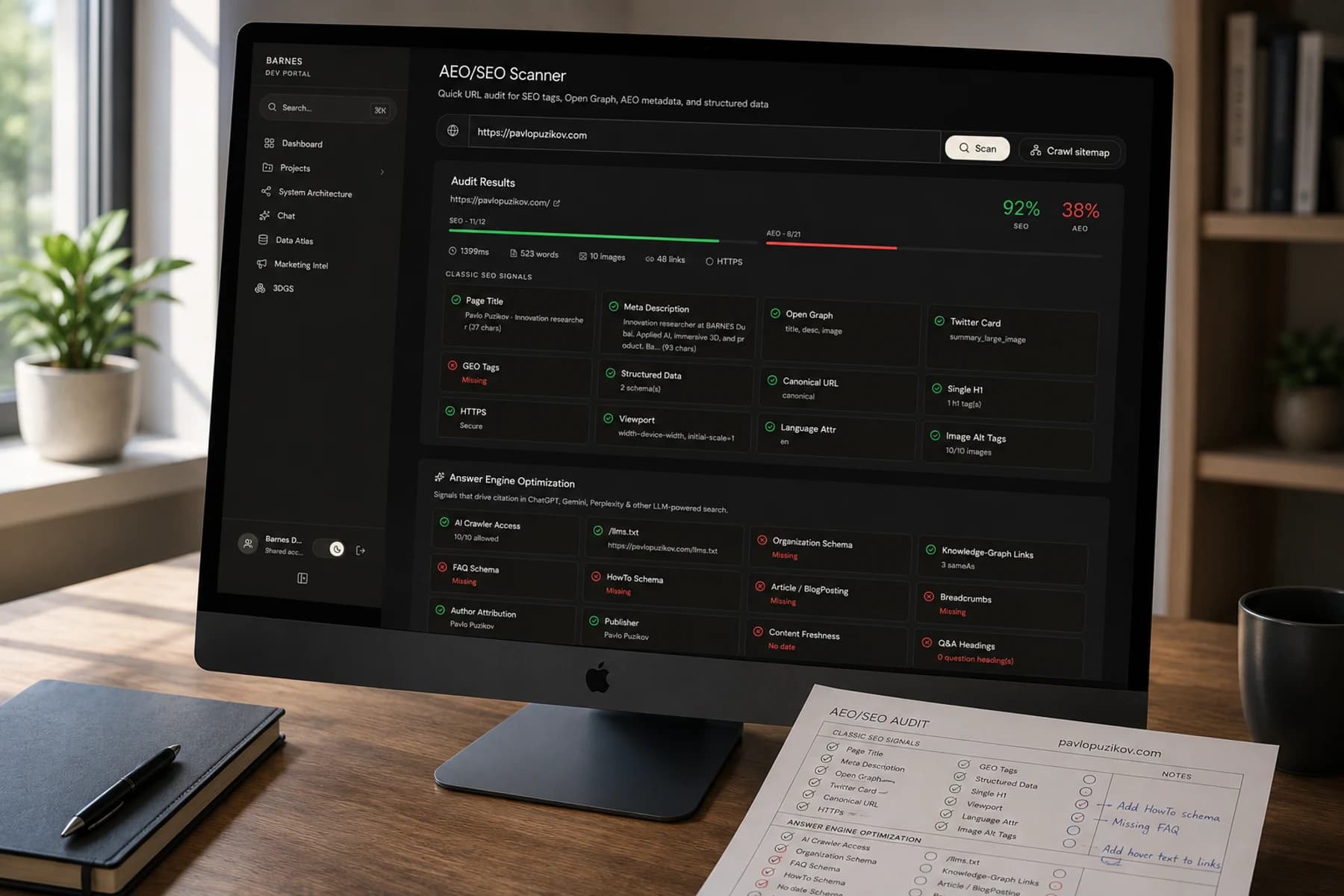
ResultLive in the BARNES Innovation Portal: paste any URL and get a real on-page audit, separate SEO and AEO/GEO readiness scores, a simulated answer-engine visibility check, and an audit-grounded action plan.

Try the live audit
SEO, AEO and GEO Toolkit cover: a single luminous query at the centre radiating fine threads out to many softer points, an abstract impression of a query rippling to many answer engines, titled 'SEO / AEO / GEO' over the line 'Found in AI answers, not just search'.

Discover

Why it exists.

Search is splitting in two. Buyers still Google, but more of them now ask ChatGPT, Perplexity, Gemini, or Claude, and those engines answer in prose, citing a handful of sources by criteria that are not Google's. A brand can own page one and never be named in the answer.

This toolkit is the instrument for that shift. It audits a page the way an answer engine reads it, scores readiness for classic search and for AI answers separately, and simulates how a brand surfaces when the question is asked conversationally, so the marketing team can act on the gap instead of guessing at it.

StackNext.js · TypeScript · Python · pandas · Prisma · Ollama · Search Console API · GA4 · Brave Search API

Define

The brief.

A luxury brand can rank #1 on Google and still go unmentioned when a buyer asks an AI assistant for the best option, so measure and win visibility in AI answers, not just blue links.

Develop

What it took

Skills behind it.

Primary discipline plus the support stack.

Skills demonstrated

  • A research playbook separating SEO (Google), AEO (answer-engine citation), and GEO (generative-engine) visibility, turned into an audit + scoring toolkit a marketing team can run on any URL.

  • ResearchSecondary

    Distilled how answer engines decide what to cite, and how differently that is from how Google ranks, into the handful of signals worth acting on.

  • A web audit surface that reads a live page the way a crawler does, returns separate SEO and AEO scores, and keeps a history the marketing team works from.

  • A first-party measurement layer that reads Google Search Console and GA4 locally, via Google's own APIs with a CSV-paste fallback, and turns the data into quick wins, query clusters, content gaps, title and meta CTR fixes, and a weekly report.

  • A visibility simulation that estimates how a brand surfaces in conversational answers, plus an audit-grounded action plan, built on swappable, mostly-local model providers.

Develop · Build

How it came together.

  1. 01

    Separate the signals: SEO, AEO, GEO

    Classic SEO checks score one axis; a second pass scores answer-engine readiness against the signals those engines actually weight, structure, attribution, freshness, and the like. The two are reported apart, because a page can ace one and fail the other.

    Marketing & BD
  2. 02

    Audit what the engines actually read

    The scanner reads the live page the way a crawler does, its structure, its structured data, and the lever most sites miss: whether the site even allows the AI crawlers at all. The recurring surprise across audits was how often a brand simply blocks the very engines it wants to be cited by.

    Research
  3. 03

    Simulate visibility, honestly

    Live, stable tracking of who an assistant cites is not a solved API. So the toolkit estimates it: it asks the question the way a buyer would, across variations, and checks whether the brand shows up, where, and in what light. A directional instrument, the UI is explicit that it simulates rather than guarantees.

    AI & Machine Learning

Develop · Forks

Decisions on the record.

The few calls worth defending. Each one is a fork; the other branch would have been a different project.

  1. Decision · 01

    Why three scores, SEO, AEO, and GEO, not one

    Google ranking and answer-engine citation are different games. A page can clear every classic SEO check and still never be quoted by ChatGPT because it lacks schema clarity, source attribution, or simply blocks GPTBot. Scoring SEO and AEO/GEO separately makes the gap legible instead of hiding it inside one vanity number.

  2. Decision · 02

    Why a transparent score, not a black box

    A marketing lead has to defend recommendations to a stakeholder. Each point of the readiness score maps to a concrete, checkable signal rather than a model's guess, so every number traces back to something you can see on the page and fix.

  3. Decision · 03

    Why simulate answer-engine visibility, not claim live tracking

    Honestly measuring whether ChatGPT cites you in real time is not a solved, stable API yet. So the toolkit estimates it instead: it asks the question the way a buyer would and checks whether, where, and how the brand shows up. A directional instrument, not a guarantee, and the UI says so.

  4. Decision · 04

    Why first-party Search Console data, kept local, not a third-party SEO platform

    The popular shortcut is to grant a hosted SEO tool read access to your Search Console and Analytics. That hands your entire query history to a third party for a dashboard you could build yourself. The first-party layer talks to Google's own APIs locally instead, so the data never leaves your control, and it still produces the quick-win, clustering, content-gap, CTR, and weekly-report output a marketing team acts on.

Try it

Audit a page, live.

Pick an example or paste a URL to see SEO, AEO, and GEO readiness scores, the on-page signals, AI-crawler access, and a prioritised action plan. Sample data here; the live tool runs on first-party Search Console and GA4.

Deliver

What shipped.

LiveLive in the BARNES Innovation Portal: paste any URL and get a real on-page audit, separate SEO and AEO/GEO readiness scores, a simulated answer-engine visibility check, and an audit-grounded action plan. A companion first-party layer reads Google Search Console and GA4 locally and returns quick wins (queries ranking 5 to 15), topic clusters, content gaps, title and meta CTR fixes, and a weekly report, so one instrument covers both what AI answers cite and what real search traffic does.

Live in the BARNES Innovation Portal, with a Python content-analysis CLI alongside it. Scoring is fully transparent, every point traces to a checkable rule, and the playbook behind it deliberately separates the defensible tactics (schema, attribution, freshness, crawl access) from the unverifiable growth-hacking claims that circulate about AI search. Google Search Console integration and per-engine citation tracking are the next steps, stated as roadmap, not present claims.

By the numbers

3

Surfaces scored

SEO · AEO · GEO

10

AI-crawler policies audited

the access most sites miss

0-100

Transparent readiness score

every point traces to a signal