
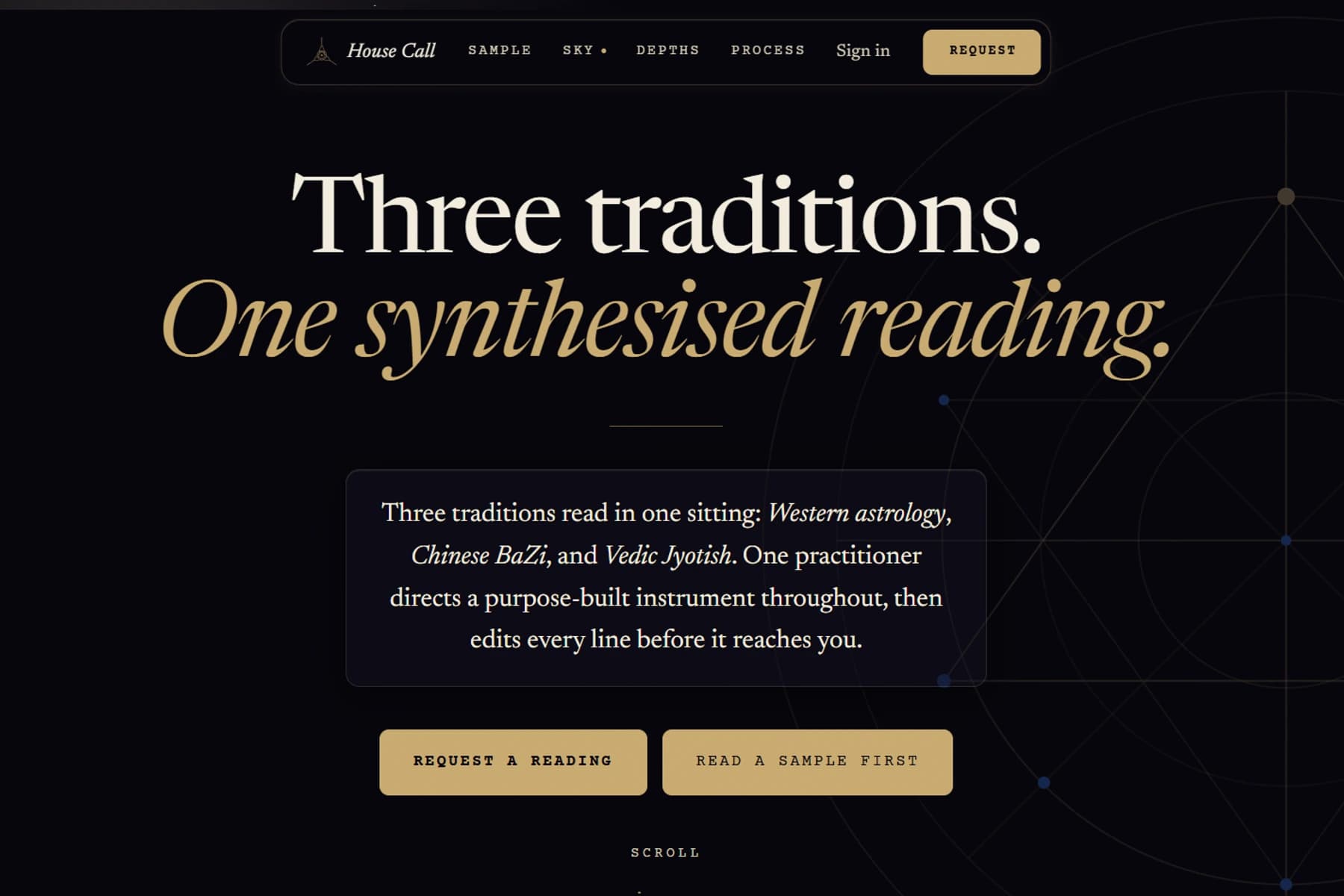
Multi-tradition natal-reading practice. Hand-prepared readings synthesise Western, Chinese BaZi, and Vedic Jyotish, backed by per-user accounts, daily astronomy-engine transits, a falsifiable prediction tracker, synastry, and tarot import. A free chart snapshot is open to anyone; the full reading is by application.
Live at housecallastro.com.
Why it exists.
Most natal-chart software treats traditions as separate islands: pick Western, Vedic, or BaZi, and stay in it. Practitioners who synthesise across traditions in practice have nowhere to host that synthesis as a product.
House Call is that host. Hand-prepared readings that braid Western (Vronsky lineage), Chinese BaZi, and Vedic Jyotish into one document, with real product infrastructure underneath it rather than a one-off PDF.
The brief.
Host a three-tradition natal-reading practice that scales by depth, not sign-up volume, with intimacy and per-user privacy as preconditions.
What it took
Skills behind it.
Primary discipline plus the support stack.
Skills demonstrated
- Product Strategy
Synthesised three-tradition reading practice with falsifiable prediction tracking; open sign-up, with the full reading by application.
- Frontend Engineering
Next.js reading surfaces over per-user auth, with accessibility overrides driven from user settings.
- Backend Engineering
Turso libSQL on Prisma, jose-signed JWTs, astronomy-engine transit cron, Vercel-fronted deployment.
- Web Design
Midnight + gold editorial identity with a gold orbital glyph that anchors the landing.
The build, in full.
How it came together, the decisions on the record, and the design system - kept off this page so the case study stays a read, not a scroll.
Read the full build notesWhat shipped.
Live at housecallastro.com. The free chart snapshot is open sign-up, the full multi-tradition reading is by application, and Stripe checkout is built but gated off behind an env flag until the founders' cohort closes.
Live since May 2026. Gating keeps per-reading depth intact as the cohort grows.
Western, Chinese BaZi and Vedic Jyotish, synthesised into one reading rather than run side by side
Accounts, readings, questions, predictions, tarot imports, feedback and the automation layer
Daily notes, digests, check-ins, scheduled answer publishing and the retention prunes, each with a matching route
A look inside.
01The same page redrawn in 1-bit, where a star chart loses nothing