
04·3D & Spatial
Barnes Immersive Experience
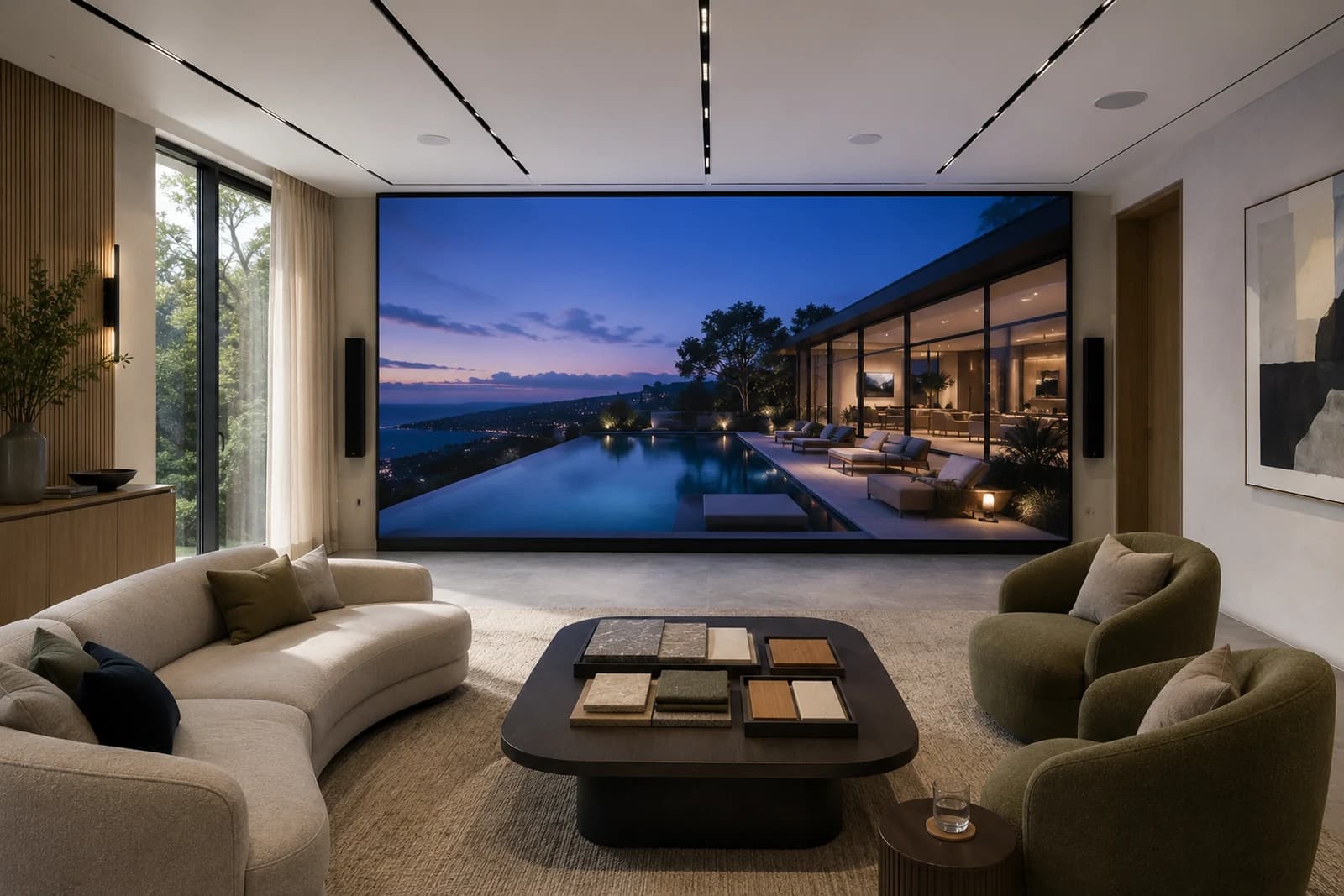
A sales room where a client explores a property in real-time 3D instead of watching a film about it. Research and a client-facing case for replacing a projector-based immersive room with LED screens and live navigation, so the room stays lit, people move freely, and the agent answers questions by flying through the building rather than cueing the next slide.
ResultA working platform, and a room that was never installed.
[ Ask about this build ]01Discover
Why it exists.
A colleague's initiative: replace a projector-based immersive sales room with LED screens and live navigation, so a client explores a property in real-time 3D instead of watching a film about it. The contribution here was the research underneath that pitch, and review input on the decks it was made with.
The standing question was what the capture-to-display chain actually requires: which phases existing vendors genuinely cover, and which are integration work someone has to own. Two room formats were assessed, a three-screen Lite and a full LED Flagship, across five pipeline phases from capture to share.
The room was never installed. The platform that would drive it was built anyway, because the argument above is only worth as much as the thing it describes, and a working surface answers questions a deck cannot.
02Define
The brief.
Work out whether a real-time, film-quality property room is buildable today, say plainly which parts of it are not, and build the software that would drive it.
03Develop
What it took
Skills behind it.
Primary discipline plus the support stack.
Skills demonstrated
- Frontend EngineeringPrimary
Built the platform as two synced surfaces, a client-facing wall display and an agent-facing tablet console, over one store and one transport hook, with asset ingest and a multi-format viewer, so pressing launch on the tablet changes the wall without either screen owning the room.
- ResearchSecondary
Implementation research (Barnes Immersive Experience vol.2) on what a real-time, film-quality property visualisation actually requires: engine choice, prerendered versus live geometry, and where a live conversational-analysis layer could feed the agent hints mid-session.
- 3D & SpatialSecondary
Technical-feasibility read on the capture-to-display chain: which phases existing vendors genuinely cover, and where the integration between them is manual and fragile because the tooling was mostly built for VR headsets and desktop, and a large LED room is neither.
- Creative Content QA & IdeationSecondary
Sense-checked the technical claims in the client-facing decks before they reached a developer audience, so nothing was promised in a meeting that the tooling could not actually do.
- Marketing & BDSupporting
Helped put the argument in sales terms rather than specification terms.
Develop · Notes
The build, in full.
How it came together, the decisions on the record, and the design system - kept off this page so the case study stays a read, not a scroll.
Read the full build notes04Deliver
What shipped.
A working platform, and a room that was never installed. Two surfaces stay in sync: a wall display the client looks at and a tablet console the agent holds. Neither is a host and neither is a follower, because the state layer was widened past the one-broker-to-many-viewers shape it was ported from, and that is what leaves room for the showroom's coffee table to become a third driver later. One store holds the room's state and one hook owns the transport, which is what lets the whole room run inside a single browser for a demo with no relay at all. It ingests 5 model formats (.ply, .splat, .lcc, .glb, .gltf) and switches renderer on what it detects, so a Gaussian scan and a standard mesh both just open. The written half is Barnes Immersive Experience vol.2, implementation research for Barnes clients in Riyadh; the rest was advising on where the vision was technically sound and where it needed a different approach.
By the numbers
Model formats ingested
.ply, .splat, .lcc, .glb, .gltf
Synced surfaces
wall display and tablet console
Room formats assessed
3-screen Lite, full LED Flagship
Pipeline phases reviewed
capture to share
Research origin
The paper-to-product thread this project sits inside. The full chain, paper through benchmark to shipped, is on the thread.
- 3D Gaussian SplattingSee thread
Turning ordinary photographs of a real place into a 3D scene you can walk through in a browser.
Frames
Selected from the work.
2 frames
01The real room today. The cover above is a visualisation of what the research argues for 02The table from that room, running the floor-plan navigator
See also
3D & Spatial
Barnes Vantage
An international portal for viewing real Dubai residences in 3D: walk a real scan yourself, or have a broker drive the same walkthrough live.
3D & Spatial
3DGS Research Pipeline
A reproducible harness with 26 Gaussian-splat engines wired into it, scoring which reconstruction survives a real luxury interior.