
17·3D & Spatial
3DGS Research Pipeline
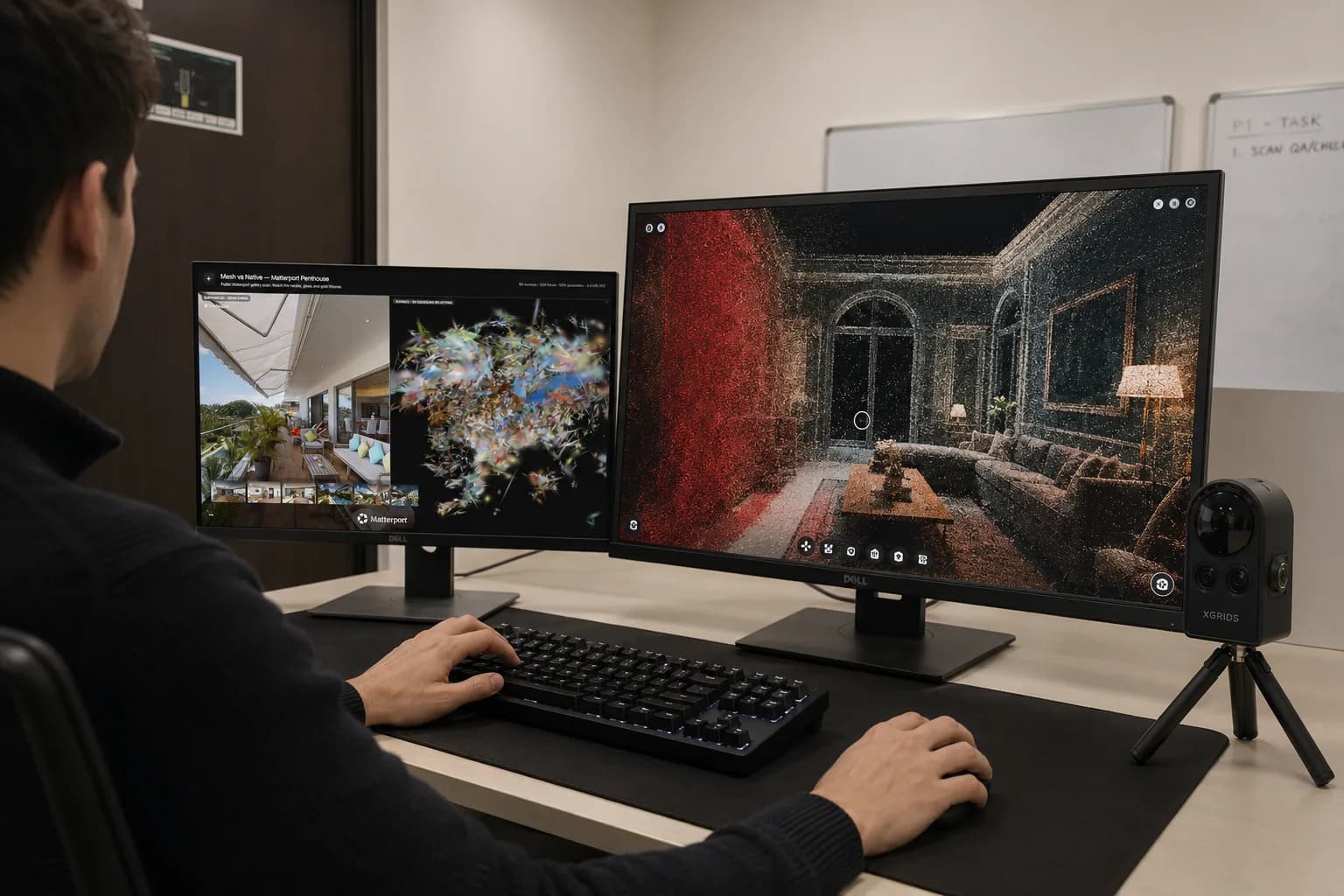
26 Gaussian-splat engines integrated into one benchmark harness, evaluation closed before the full matrix. Which one actually survives a real luxury-interior scan, not just the leaderboard.
A reproducible benchmark harness: 26 engines wired, a scan-difficulty taxonomy, and per-engine failure modes, feeding the academic papers.
[ Ask about this build ]Why it exists.
The brief said nothing about Gaussian splatting. It said find a better way to show property than Matterport, which every brokerage already had, and which made every brokerage's tours look like every other brokerage's tours. The answer was not another capture vendor, it was that the underlying method had changed: 3DGS.
3D Gaussian Splatting moved fast between 2023 and 2026, with new engines shipping every quarter, each claiming higher PSNR on its own benchmark scenes.
This pipeline is built to answer it: 26 Gaussian-splat engines wired into one harness, evaluation closed before the full matrix, across scans from a clean studio booth through a mirror-walled marble lobby to a city-scale neighbourhood capture.
The pipeline also covers the unbuilt case: novel-view synthesis via video diffusion, monocular depth lift, and the hybrid stack that bolts those onto a real scan when only half a building has been constructed.
The brief.
Answer which Gaussian-splat engine actually survives a luxury real-estate brief on a real scanner, not which one wins average PSNR on clean studio scenes.
What it took
Skills behind it.
Primary discipline plus the support stack.
Skills demonstrated
- Research
One harness spanning studio scans to city-scale capture; the PSNR/SSIM/LPIPS comparison closed before the full matrix.
- 3D & Spatial
Novel-view synthesis and monocular depth paths for unbuilt properties stitched into the same pipeline.
- AI & Machine Learning
Video-diffusion novel-view models evaluated against COLMAP-grounded baselines.
- Data Pipelines
The eval harness itself: per-engine launch scripts, logged failure modes, reproducible runs.
The build, in full.
How it came together and the decisions on the record - kept off this page so the case study stays a read, not a scroll.
Read the full build notesWhat shipped.
A reproducible benchmark harness: 26 engines wired, a scan-difficulty taxonomy, and per-engine failure modes, feeding the academic papers. The comparison has closed, short of the full engines-by-scans matrix, so it names no winner. A relighting track ran alongside it: an interactive viewer with movable light fixtures and real soft cast shadows, plus delighting and relightable retraining that was still in progress when BARNES Dubai ceased operations in 2026.
The write-up is finished, four pages and anonymised for double-blind review, though not yet submitted. The engine comparison is closed. It stopped before the full matrix, so it names no winner, but its early results shaped which engine was tried behind Barnes Vantage.
PSNR/SSIM/LPIPS; stopped before the full matrix, no ranked winner
The paper-to-product thread this project sits inside. The full chain, paper through benchmark to shipped, is on the thread.
- 3D Gaussian SplattingSee thread
Turning ordinary photographs of a real place into a 3D scene you can walk through in a browser.
- Mirrors and glass captureSee thread
The open problem Gaussian Splatting still hasn't solved for high-end interiors.
See also
Relighting a Real Scan
Per-Gaussian relighting of a real 3D Gaussian-splat capture in the browser, driven by a real solar ephemeris, with the negative results reported alongside.
Barnes Vantage
An international portal for viewing real Dubai residences in 3D, where a buyer walked a real scan alone or followed a broker driving it live.