06·Research
SIGGRAPH Asia 2026
Tech Communications track submission on applied 3D Gaussian Splatting in luxury real-estate visualisation. Documents the pipeline from interior scans through AI-generated novel-view synthesis to city-scale capture.
What it took
The skills behind this project.
Every project below leans on a primary discipline and a handful of secondary ones. Tap any chip to see how that skill plays out across the wider portfolio.
Skills demonstrated
- ResearchPrimary
First-author Tech Communications submission framing applied 3DGS for luxury real-estate visualisation.
- 3D & SpatialSecondary
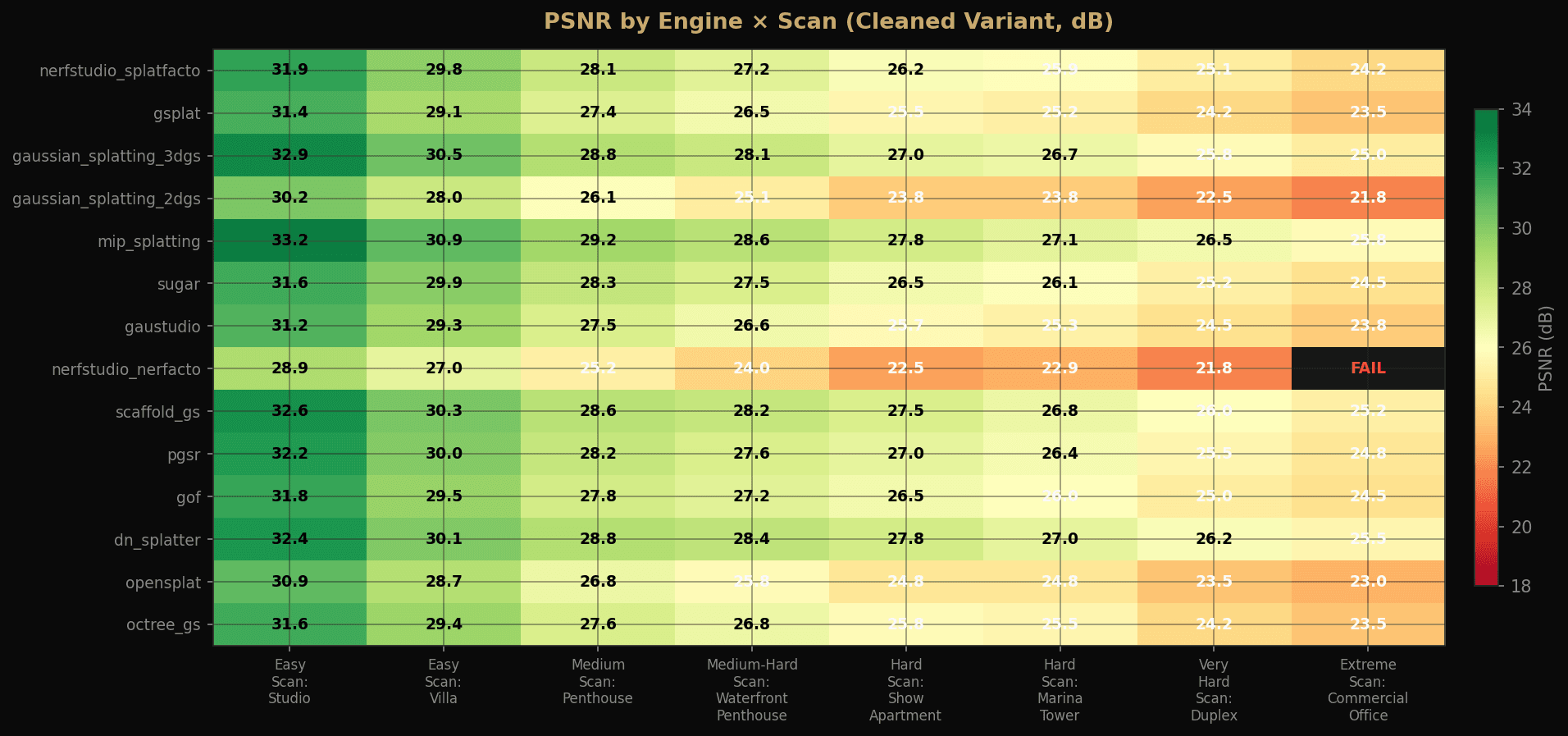
Engine benchmark and scan-difficulty taxonomy from Easy Studio through Extreme Commercial Office.
- AI & Machine LearningSecondary
Novel-view synthesis comparison across diffusion-based and photogrammetric baselines.
- Data PipelinesSupporting
PSNR / SSIM heatmaps and per-engine robustness scoring.
Context
Why it exists.
The 3DGS research pipeline produced enough evidence to argue something contentious in the field: applied 3D Gaussian Splatting in luxury real-estate visualisation is bottlenecked not by quality but by robustness, and the engine that wins on average PSNR is not the engine that survives the failure modes a brokerage actually encounters.
The Tech Communications track at SIGGRAPH Asia 2026 is the right venue — it is the track for industry-validated applied work, not theoretical novelty. The submission frames the eval framework, surfaces the heatmap as the central artefact, and argues for failure-mode reporting as a first-class metric in 3DGS benchmarks.
Stack3DGS · Novel-view synthesis · Video diffusion · Research writing
Process
The decisions that shaped it.
- 01
Lead with the heatmap, not the average
Submission opens with the PSNR-by-engine × scan heatmap, with failure cells highlighted in red, before the per-engine averages are introduced. Forces the reviewer to confront robustness before they reach for the leaderboard.
Research - 02
Seven scan-difficulty bands as the spine of the eval
Easy Scan-Studio through Extreme Commercial-Office. Each band selected for distinct failure modes — texture sparsity, specularity, scale ambiguity, lighting variance. Reviewers can challenge the band definitions but not the spread of conditions covered.
Research - 03
Reproducibility is the second contribution
The submission ships with the eval harness, the scan-difficulty rubric, and the per-engine launch scripts. The first contribution is the result; the second is the framework anyone else can run on their next engine release.
Data Pipelines
Outcome
What shipped.
Submitted July 2026. Review outcome pending; regardless of acceptance, the eval framework is in production use guiding which 3DGS engine ships behind Splat Viewer for each property type. The submission also doubled as a forcing function to clean up the engine-by-engine documentation and the failure-mode taxonomy.
Inside
4 moments worth a closer look.
01Per-engine rows
Each row is one of 11 3DGS engines benchmarked: nerfstudio_splatfacto through scaffold_gs. Sorted by mean PSNR across scans.
02Per-scan columns
Seven scan difficulty bands, Easy Scan-Studio through Extreme Commercial-Office. Difficulty rises with scale + texture sparsity.
03Engine failures
Red 'FAIL' cells mark engines that crashed or produced unusable output on the hardest scenes. Robustness, not just average quality, drives the SIGGRAPH submission.
04Best-in-class
Top PSNR (~31 dB) consistently lands with mip-splatting + gaussian-splatting variants on clean studio scans. Choice of engine matters more than expected at the easy end.