
12·3D & Spatial·Passion project
Future Office View
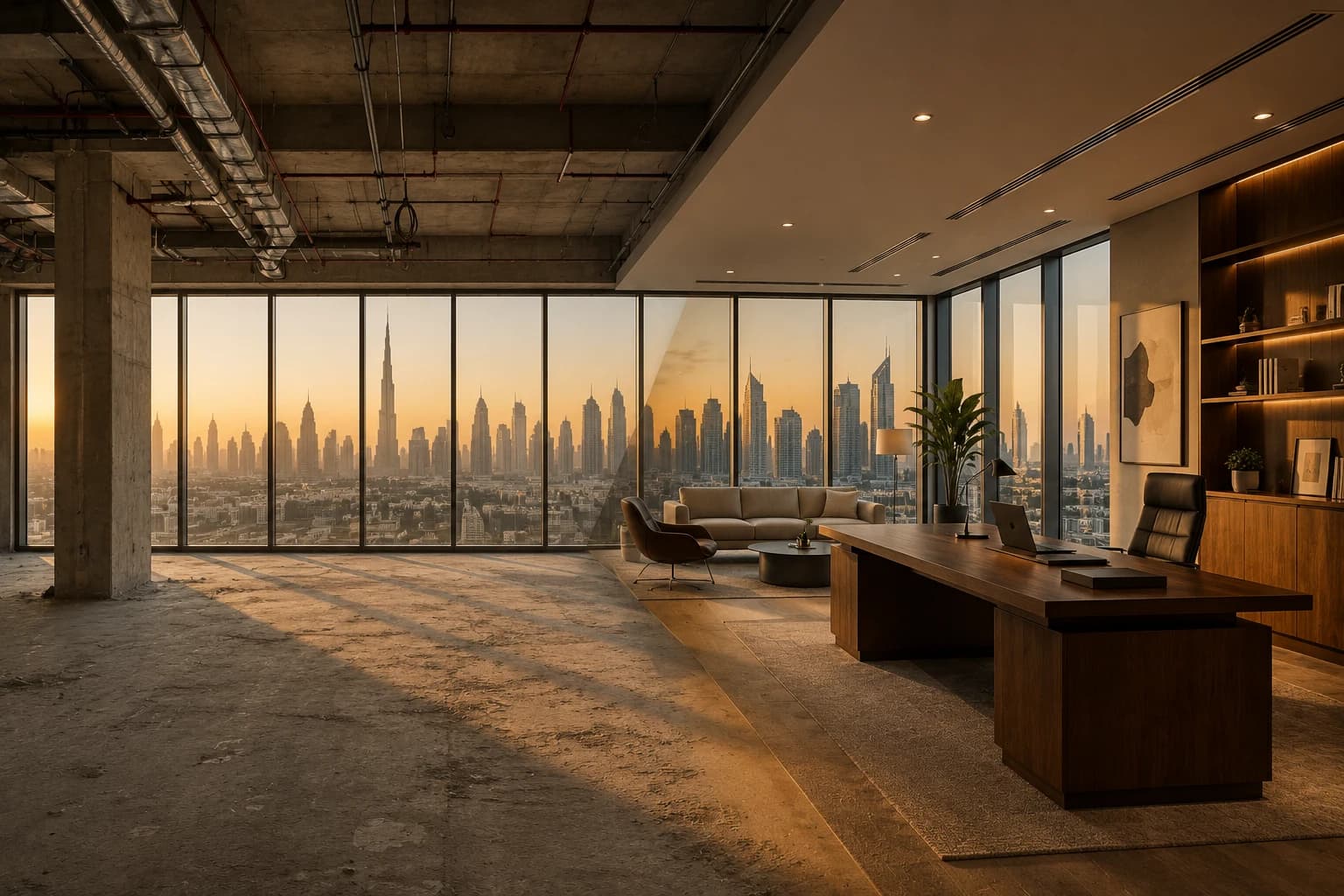
Virtual office staging proof-of-concept. Takes a real listing photo and produces convincing workplace concepts via image-to-image diffusion while preserving room geometry (walls, windows, perspective). Six prompt styles, three occupancy levels, multi-model comparison across GPT-Image, Flux Kontext, and Gemini Nano Banana.
ResultDemo, landlord-admin, and concept pages all self-contained for live client walkthrough.
Discover
Why it exists.
Commercial listing photos show empty rooms. Buyers cannot read empty rooms, they need to see the space staged for the way they would use it. Physical staging is too expensive for commercial; virtual staging via diffusion is cheap, but most attempts smear the room geometry and the listings look generated.
Future Office View is the proof-of-concept that asks one question: can an off-the-shelf image-to-image model preserve room geometry, walls, windows, ceiling, perspective, well enough to ship? Stage 1 is a prompt library, a four-page static HTML walkthrough for live client demos, and a side-by-side model-comparison rig run manually in FloraFauna across GPT-Image, Flux Kontext, and Gemini Nano Banana.
Deliberately not import-ready yet. The point of stage 1 is to learn which model survives the trust test before any production worker exists.
StackDiffusion models · Prompt engineering · FloraFauna · Next.js
Develop
What it took
Skills behind it.
Primary discipline plus the support stack.
Skills demonstrated
- AI & Machine LearningPrimary
Image-to-image diffusion that preserves room geometry across six prompt styles and three occupancy levels.
- Web DesignSecondary
Demo, landlord-admin, and concept surfaces tuned for in-room client walkthrough.
- Frontend EngineeringSecondary
Next.js + FloraFauna comparison rig with side-by-side GPT-Image, Flux Kontext, and Gemini Nano Banana outputs.
- ResearchSupporting
Multi-model prompt-adherence study on geometry preservation across diffusion families.
Develop · Build
How it came together.
- 01
Prompt library as a deterministic compose function
The prompts are not strings copy-pasted into a chat window. They are a TypeScript library, six styles × four layouts × three occupancy levels × two preservation-strictness modes × two watermark policies, composed by a pure
AI & Machine Learningcompose()function that returns deterministic text plus a sha256 hash. The hash becomes the dedupe key in Phase 2; until then it makes runs reproducible across reviewers. - 02
Four static HTML pages, four audiences
demo.html (tenant-facing showcase), landlord.html (the four-step back-office workflow with cost / latency / budget metrics), poc.html (internal concept document with the four-phase roadmap), compare.html (an inline scoring tool that exports five-criterion scores to markdown). All four are self-contained, a sales advisor opens demo.html in a client meeting and nothing on the network needs to respond for it to work.
Web Design - 03
FloraFauna runs the model comparison
Used FloraFauna to run the same prompt across GPT-Image, Flux Kontext, and Gemini Nano Banana in one operation, then scored outputs against a five-criterion rubric in compare.html. Skipped building a self-hosted comparison rig because stage 1's job is to learn, not to ship, the rig comes in Phase 2 once the winning model is chosen.
Research - 04
Watermark policy baked into the prompt
The prompts instruct the model to paint over the source watermark cleanly, so no pre-cropping is needed; the production worker re-composites the official brand mark via
sharponly at the final stage. Keeps the demo loop fast, paste prompt, get image, score, without an intermediate Photoshop step.
Deliver
What shipped.
Demo, landlord-admin, and concept pages all self-contained for live client walkthrough.
Stage 1 complete: prompt library shipped with nine passing unit tests, four-page demo walkthrough usable in client meetings, model-comparison rubric filled in across the three diffusion models. Stage 2 (production worker + landlord admin) is gated on the comparison results, the technique earns its build only if the geometry-preservation evidence holds.